Why Your Growth-Stage Company Needs Earned Media (Even If You've Never Thought About PR)
If you're running a $5M-$20M B2B company, PR probably isn't on your radar. You're focused on sales pipeline, customer retention, and managing costs. When you think about marketing at all, you're thinking about your website, maybe some Google Ads, perhaps a trade show or two.
Here's what changed in the past 18 months: the way your buyers research solutions before they ever talk to your sales team.
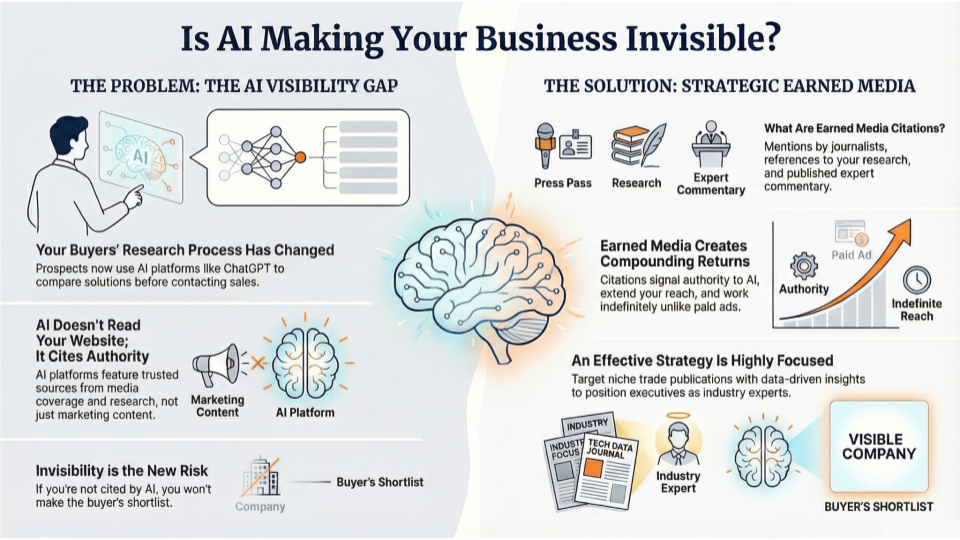
When a prospect asks ChatGPT or Perplexity to compare solutions in your industry, those AI platforms don't just regurgitate your website content. They cite sources they consider authoritative. If your brand isn't among those cited sources, you're invisible in the research process that increasingly drives purchase decisions.
This isn't theory. Here's the pattern I'm seeing across 15+ years managing B2B marketing in aerospace, healthcare, and manufacturing: buyers are conducting more research through AI platforms before engaging vendors. The companies winning those early-stage considerations aren't necessarily the ones with the biggest websites—they're the ones getting cited as trusted sources.
The Real Cost of Invisibility
Let's talk about what this actually means for your business.
Your sales team probably already tells you that prospects are more educated when they first engage. They've done research. They've compared options. They often have a shortlist before making contact.
If your brand isn't visible during that research phase—if AI platforms aren't citing your company or executives as sources when prospects ask about solutions—you're not making that shortlist. You're losing opportunities before you even know they exist.
The companies that are getting cited? They're the ones that journalists quote. They're the ones publishing research that others reference. They're the ones participating in industry conversations beyond their own websites.
In other words: earned media.
Why Earned Media Actually Matters Now
I know what you're thinking. PR sounds expensive, slow, and difficult to measure. You're not wrong—traditional PR agencies often fail to connect media coverage to business outcomes.
But here's what I've learned managing marketing for B2B companies across aerospace, defense, healthcare, and technology: earned media creates compounding returns in ways paid advertising never will.
When a trade publication quotes your CEO about industry trends, that creates a citation. When your company's research gets referenced in another company's content, that creates a citation. When you speak at an industry conference, and the transcript gets published, that creates citations.
These citations do three things:
- They signal authority to AI platforms. When ChatGPT needs to answer questions about your industry, it draws from sources it deems credible. Media coverage and earned citations build that credibility signal.
- They extend your reach beyond paid channels. A prospect who would never click your Google Ad might read a trade publication article that cites your company. You're entering consideration sets you couldn't reach through traditional marketing.
- They work indefinitely. Unlike ads that stop when budgets end, earned citations continue working. An article published this year can influence buyer research for years to come.
The Strategic Question: Build or Buy?
Here's the decision framework I walk CEOs through when they're considering earned media strategy:
Option 1: Do nothing different. Continue investing in your current marketing mix and accept that you'll be less visible in AI-driven research. This might be fine if you have strong channel relationships or sell primarily through referrals.
Option 2: Add earned media tactically. Participate in industry events, publish occasional thought leadership, and respond to journalist queries when opportunities arise. This costs mainly time—your executives' time specifically.
Option 3: Build a systematic earned media strategy. Develop proprietary research, create a thought leadership content calendar, build relationships with industry journalists, and position executives as expert sources. This requires either internal resources or external support.
Most growth-stage companies I work with don't have the internal capability for Option 3. You don't have a communications team. Your CEO and functional leaders are busy running the business.
That's where fractional marketing leadership makes sense—someone who can develop the strategy, identify the highest-value opportunities, and coordinate execution without requiring full-time overhead.
What "Good" Actually Looks Like
The most effective earned media strategies I've developed for clients share common characteristics:
Industry-specific focus. You're not trying to get covered in The Wall Street Journal. You're targeting the three or four trade publications your prospects actually read.
Data-driven thought leadership. Original research, benchmark studies, or market analysis that provides genuine value to your industry. This gets cited because it's useful, not because it's promotional.
Executive positioning that serves business goals. Your CEO doesn't need to be a household name. They need to be known among the 500 companies in your target market as someone who understands the industry.
Measurable connection to pipeline. You track which prospects mention seeing your coverage, which media placements drive website traffic, and which thought leadership pieces get referenced in sales conversations.
The Real Talk About Investment
A systematic earned media strategy requires investment, whether that's your executives' time, external support, or both.
The question isn't whether it costs money. The question is whether the return justifies the investment, given your business goals and competitive position.
If you're in a crowded market where buyers actively research solutions before engaging vendors, earned media can significantly reduce customer acquisition costs by getting you into earlier consideration.
If you're in a niche market where everyone knows each other anyway, the ROI is less clear.
If you're facing larger competitors with bigger marketing budgets, earned media can level the playing field by building authority through strategic positioning rather than spending volume.
If you primarily win through existing relationships and referrals, earned media may not be your highest-priority marketing investment.
Where to Start
If this feels relevant to your business, start with these questions:
Where do your prospects research solutions before contacting vendors? If the answer is "AI platforms," or "trade publications," or "industry association resources," the earned media strategy becomes more valuable.
Do you have proprietary insights worth sharing? Unique data about your industry, perspectives from your market position, or operational experience that would genuinely help others understand market dynamics?
Can you commit executive time? Earned media requires your leadership team to participate—you can't fully outsource this. If they're willing to invest time in strategic interviews, content development, and industry participation, you can build a meaningful presence.
What's your timeline? Earned media builds authority over quarters and years, not weeks and months. If you need an immediate pipeline, this isn't the right approach.
The transformation of B2B buyer research is already happening. Your prospects are using AI platforms to evaluate solutions. The question is whether your brand will be visible when they do.
Next Steps Worth Considering
Audit your current earned media presence. Search your company and executives in AI platforms. Look at what gets returned. Check your citation frequency in industry publications over the past year.
Identify your target media. Which three to five publications do your ideal customers actually read? Who are the journalists covering your sector?
Assess your executive bandwidth. Which leaders have unique insights and the willingness to participate in thought leadership?
Decide your approach. Whether you pursue this internally, with a fractional marketing director's support, or through agency partnership should depend on your internal capability and strategic priorities.
I help growth-stage B2B companies develop marketing strategies that drive measurable business outcomes—including earned media approaches designed for AI visibility. If you're between $3M-$25M in revenue and trying to determine whether systematic earned media belongs in your marketing mix, let's have a conversation.
No sales pitch. Just a straightforward discussion about whether this approach makes sense for your business.