Why Your B2B Marketing Fails: The ICP Problem No One Talks About
Skipping your end-of-year marketing review isn't saving you time. It's costing you money.
Let me guess: you're thinking about skipping the end-of-year marketing review this year. You're slammed. Q4 is chaos. And honestly, you're not sure what you'd even review—marketing feels like this scattered collection of activities that may or may not be working.
I get it. When I talk to CEOs of growth-stage companies, this is exactly what I hear. Marketing is happening, money is being spent, but there's no clear line connecting that spend to actual revenue. The temptation to just "keep doing what we're doing" and revisit it "when things calm down" is real.
Here's the problem: skipping your end-of-year marketing review isn't saving you time. It's costing you money.
The Real Cost of Wasted Marketing Spend
If your company is doing $3M to $25M in annual revenue, you're likely spending somewhere between $50K and $300K on marketing annually. That's real money—money that could go toward hiring, R&D, or expanding operations.
Now ask yourself: do you know which parts of that budget actually generated revenue?
Most growth-stage CEOs I work with can't answer that question with confidence. They know they're running Google Ads. They know they exhibit at certain trade shows. They know they have an SEO agency sending monthly reports. But when you ask them to connect those activities to closed deals, the conversation gets vague fast.
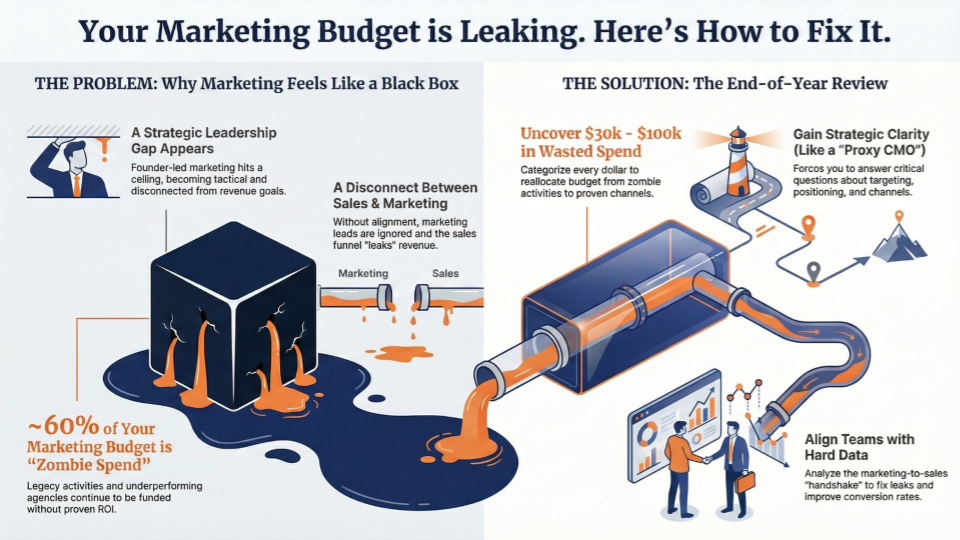
This is the "black box" problem. Money goes in, and hopefully leads come out, but the mechanism inside is completely opaque. Without an end-of-year review, you're flying blind—continuing to fund activities based on inertia rather than evidence.
Here's what I typically find when we conduct a proper review: about 60% of marketing spend is "zombie spend"—legacy activities that continue simply because "we've always done them." That trade show you've attended for five years? It generated 47 business cards and zero closed deals. That SEO agency? They're optimizing for keywords that drive traffic but not conversions. That monthly retainer for social media management? No one on your sales team can point to a single deal that originated from social.
The end-of-year review forces you to categorize every dollar of spend into three buckets: Run the Business (essential maintenance), Grow the Business (proven lead generation with positive ROI), and Transform the Business (experimental bets). This simple exercise typically reveals $30K-$100K that could be reallocated from zombie activities to channels that actually drive revenue.
The Marketing Leadership Gap
The second reason you can't skip this review is more strategic: you need someone thinking like a CMO, even if you can't justify hiring one.
This is the phase where founder-led marketing hits a ceiling. You got to $3M-$10M on your personal network, your salesmanship, your hustle. But scaling to $25M requires a different approach—one where marketing is a systematic revenue engine, not an extension of the founder's Rolodex.
The economics don't support hiring a full-time Marketing Director at $180K+ (salary, benefits, equity). But without that strategic leadership, marketing stays tactical and scattered. You're posting on LinkedIn because someone said you should. You're running ads because your competitor is. You're redesigning the website because it "looks dated." None of this is connected to a coherent strategy.
The end-of-year review functions as your proxy CMO. It forces the strategic questions that a full-time marketing executive would ask:
Who exactly are we targeting, and has that changed?
What's our positioning versus competition?
Which channels align with how our buyers actually make decisions?
Where are the gaps between marketing and sales?
Without this annual forcing function, these questions never get asked. Marketing continues on autopilot, and you wonder why it feels like you're spending more but getting less.
The Sales and Marketing Disconnect
Here's a pain point I hear constantly: "Our sales team needs better leads."
Fair enough. But here's what I find when we dig into the data: marketing is generating leads, but sales isn't following up. Or sales is following up, but only on the "hot" leads and ignoring everything else. Or there's no agreed-upon definition of what a "qualified lead" even means.
This isn't a marketing problem or a sales problem—it's an alignment problem. And alignment problems only get solved when you force both teams into the same room with the same data.
The end-of-year review analyzes the "handshake" between marketing and sales. It tracks the velocity of a lead becoming an opportunity. It identifies "leakage"—leads that marketing generated but sales ignored. It reveals that your cost-per-lead isn't the problem; your lead-to-opportunity conversion rate is.
For B2B companies with long sales cycles—healthcare, aerospace, manufacturing—this analysis is critical. Your sales cycle might be 12-18 months. If you're only looking at this month's leads, you're missing the full picture. The review implements cohort analysis: it looks at the leads generated in Q1 of the previous year and analyzes their revenue realization in the current year.
This reveals patterns you can't see in real-time. It shows you that leads from LinkedIn take longer to close but have higher deal values. It shows you that trade show leads convert faster but have lower lifetime value. This intelligence allows you to optimize your mix for the coming year.
The Agency Accountability Problem
Let's talk about the vendors. If you're like most growth-stage companies, you're working with multiple agencies or freelancers—one for PPC, one for SEO, one for web development, maybe one for content.
How do you know if they're actually performing?
Most CEOs I talk to admit they don't really know. They get monthly reports full of charts and metrics, but they can't translate those metrics into business outcomes. Open rates, impressions, keyword rankings—these are activity metrics, not outcome metrics.
The end-of-year review applies a rigorous scorecard to every external partner. It asks:
Did organic traffic actually submit forms, or just bounce?
What was the customer acquisition cost, by channel, and blended?
How are the cost per lead and cost per sale trending QoQ and YoY?
How is customer retention and lifetime value performing?
What did we do to invest in brand awareness with our target audiences?
This isn't about being adversarial with your marketing team or vendors. Good agencies welcome this level of scrutiny because it demonstrates value. Bad agencies hate it because it exposes that they've been coasting.
I've seen companies eliminate $40K-$60K in underperforming agency spend through a single comprehensive review. That's real money that can be redirected to channels that actually drive results.
The Path Forward
Look, I understand the reluctance. You're busy. Marketing feels like this amorphous thing that's hard to measure. And frankly, part of you is afraid of what you'll find—that you've been wasting money, that the strategy isn't working, that you need to make hard decisions.
But here's the truth: the end-of-year marketing review isn't just about looking backward. It's about building the foundation for next year's growth.
Without it, you enter January with the same scattered approach, the same zombie spend, the same misalignment between marketing and sales. With it, you have clarity on what's working, confidence in your budget allocation, and a strategic roadmap that actually connects to revenue goals.
For the conservative, results-oriented CEO who values substance over style, the review provides the one thing you need most: certainty. Certainty that your budget is deployed efficiently. Certainty that your message aligns with your market. Certainty that you're positioned for sustainable, profitable growth.
You don't need a full-time CMO to get this level of strategic direction. But you do need someone who can analyze the data, identify the patterns, and translate marketing activity into business outcomes.
That's exactly what a proper end-of-year review delivers. Don't skip it.
Here's the uncomfortable truth: you know you need to conduct this review, but you don't have the expertise to do it properly. You can't objectively evaluate your agencies. You don't know which metrics actually matter. And you're too close to the business to identify the zombie spend that's quietly draining your budget.
This is precisely where a fractional marketing director delivers immediate ROI—conducting a rigorous end-of-year review that categorizes every dollar of spend, scores your vendor performance, and builds a strategic roadmap for next year's growth. If you're spending $50K-$300K annually on marketing but can't confidently say what's working, that review typically uncovers $30K-$100K in reallocation opportunities. Let's have a conversation about bringing strategic clarity to your marketing investment before you enter another year on autopilot.