The Seven-Step Trade Show Marketing Framework That Actually Drives Revenue
Trade shows represent a $50K-$90K+ investment. This proven framework turns them into integrated marketing campaigns that generate $2.4M+ in qualified pipeline.
Trade shows represent a significant investment. Between booth space, travel, staff time, and promotional materials, you're easily looking at $50,000 to $90,000+ per event. The question isn't whether you should attend—it's whether you're extracting real business value from that investment.
Most companies treat trade shows as isolated events: show up, hand out brochures, collect business cards, and hope something sticks. That approach leaves money on the table.
Here's the truth: trade shows work when they're treated as integrated marketing campaigns, not standalone events. You need a systematic approach that starts weeks before the show and continues well after you've packed up your booth.
This framework has driven measurable results across industries—from aerospace manufacturers to healthcare technology companies. It's not complicated, but it requires discipline and advance planning.
The Business Case for Strategic Trade Show Marketing
Before diving into tactics, let's establish what success actually looks like.
A well-executed trade show should generate qualified pipeline—not just booth traffic. You're looking for meetings that convert to proposals, demos, and ultimately revenue. The metric that matters is cost per qualified lead and conversion rate to customers, not how many people stopped by your booth.
Second, trade shows offer concentrated access to both prospects and existing customers. That dual opportunity—new business development plus relationship deepening—justifies the investment when you execute both strategies deliberately.
Let's work with realistic numbers: a 2.5-day trade show with 20,000 attendees. Of those 20,000, roughly 10% fit your ideal customer profile—that's 2,000 potential prospects walking the floor. Your goal is to capture meaningful conversations with the right subset of that audience while deepening relationships with existing customers who are attending.
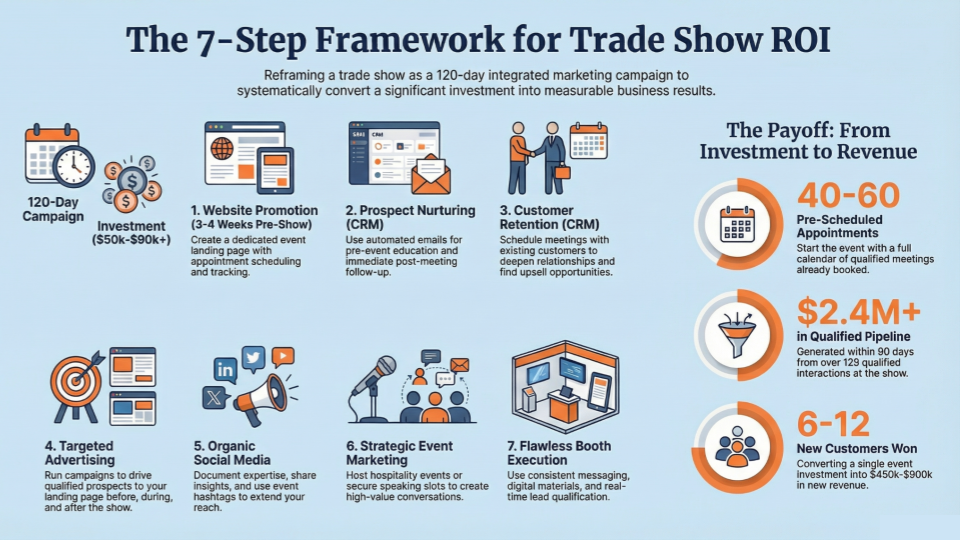
The Seven-Step Framework
This playbook works because it treats the trade show as the center point of a 120-day marketing initiative. Here's how it breaks down:
Step 1: Website Promotion (3-4 Weeks Pre-Show)
Your website should actively promote your trade show presence. This isn't about adding a banner and calling it done.
What to do:
Place a prominent message in your site header announcing your attendance and booth number
Create a dedicated landing page specifically for the event
Enable appointment scheduling directly from that page
Implement unique tracking (phone numbers, UTM parameters, event-specific analytics) so you know exactly what traffic and conversions the show generates
Why it matters: You're already driving traffic to your website through SEO, paid media, and referrals. A focused trade show campaign can drive 800-1,200 unique visitors to your event landing page. Converting even 2-3% of that traffic into pre-scheduled appointments means you're walking into the event with 10-27 qualified meetings already booked. Those appointments have significantly higher conversion rates than random booth drop-bys.
Step 2: CRM Marketing for Prospecting
Every appointment booked—whether through your website, direct outreach, or advertising—should trigger an automated nurture sequence.
What to do:
Build an email sequence that educates prospects before the event
Send appointment reminders (morning-of often works best)
Follow up immediately after the meeting with personalized notes
Route prospects into your standard lead workflows based on qualification level (MQL vs. SQL)
Why it matters: You're competing for attention at a crowded event. Pre-meeting nurture increases show-up rates to 65-75%. Post-meeting follow-up while the conversation is fresh dramatically improves conversion. Most importantly, this systematizes lead management so nothing falls through the cracks when your team gets back to the office buried in follow-up tasks.
Step 3: CRM Marketing for Customer Retention
Your existing customers are attending the same shows. If you have 25-40 customers attending a 20,000-person event, treating this purely as a prospecting opportunity misses half the value.
What to do:
Email your customer base 30 days out asking if they're attending
For those attending, schedule face-to-face meetings or invite them to hospitality events
For those not attending, commit to sharing key takeaways and insights post-show
Use these conversations to identify expansion opportunities or gather feedback
Why it matters: Customer retention drives profitability more than new customer acquisition in most B2B businesses. With a 60-70% response rate to meeting invitations, you can schedule 15-28 customer meetings. Face-to-face time deepens relationships and uncovers expansion opportunities—typically 30-40% of these conversations surface expansion or upsell possibilities. Even for customers not attending, positioning yourself as a resource builds goodwill and can surface needs you wouldn't otherwise discover.
Step 4: Advertising Campaign
If trade shows justify the expense of booth space and travel, they justify targeted advertising to maximize ROI.
What to do:
Build your advertising around your Ideal Customer Profile—target decision-makers who will actually be at the event
Create separate messaging for pre-show (building awareness), at-show (driving booth traffic), and post-show (nurturing leads who didn't convert)
Use your customer list to build lookalike audiences
Direct all traffic to event-specific landing pages with appointment scheduling
Track everything—know which ads drove which meetings and which meetings converted to pipeline
Why it matters: Advertising compresses your timeline. A properly targeted campaign can generate 150,000-250,000 impressions to your ICP, driving 750-2,500 clicks to your landing page. With conversion rates of 1-2%, you're looking at 8-50 additional appointment requests. Instead of hoping the right prospects stumble across your booth, you're actively driving qualified traffic. When properly targeted and tracked, ad spend directly correlates to booked meetings, which means you can forecast ROI before the event even starts.
Step 5: Organic Social Media
Social media at trade shows isn't about going viral—it's about extending your reach and documenting expertise.
What to do:
Develop a messaging theme aligned with your overall positioning
Schedule posts for event opening and closing each day
Capture real conversations: questions you're hearing, problems you're solving, insights from sessions
Document speaking engagements or panel participation
Use event hashtags to expand visibility
Get permission before posting photos with prospects or customers
Why it matters: Social extends the life of your trade show investment. A prospect who couldn't attend still sees your presence. A customer sees you're active in the industry. Each post is content that can be repurposed. Most importantly, documenting the questions you're fielding becomes blog content that drives long-term SEO value.
Step 6: Event Marketing
Your booth is one touchpoint. Strategic events create additional opportunities to advance relationships.
What to do:
Host a hospitality suite or dinner (plan 90+ days in advance—good venues book fast)
Theme your event around business challenges, not your company
Consider bringing in an external speaker to add value beyond networking
Pursue speaking opportunities—main stage, panels, or breakout sessions all work
Convert speaking sessions into content (blog posts, case studies, thought leadership)
Why it matters: Hospitality events change the dynamic. You're no longer competing for attention in a crowded expo hall—you're creating an environment for substantive conversations. A well-executed dinner or hospitality suite can generate 20-40 attendees, yielding 10-20 net-new qualified conversations beyond your booth traffic. Decision-makers who might not stop at your booth will accept a dinner invitation. Speaking positions you as the expert rather than the vendor. Both drive higher-quality pipeline.
Step 7: Booth-Specific Execution
Even the best pre-show marketing fails if your booth experience doesn't deliver.
Develop a consistent talking track that aligns with your positioning—everyone on your team should communicate the same core messages
Display short-form video content that supports your theme (product demos, customer testimonials, thought leadership)
Provide demos where applicable
Create digital sales materials you can email immediately—physical handouts get lost
Consider AR displays if they genuinely enhance engagement (not just novelty)
Use a badge scanner and code leads by qualification level in real-time
Route all leads immediately into your CRM prospecting workflow
Why it matters: Over 2.5 days, you'll likely see 250-300 people visit your booth. But only 30% of those—75-90 conversations—will be truly qualified prospects. Your booth is the conversion point for all your pre-show investment. Consistent messaging ensures prospects leave with a clear understanding of your value. Digital materials mean immediate follow-up. Real-time lead coding means your sales team knows who to prioritize when they get back. Badge scanning prevents "I thought you were following up on that lead" conversations.
The Timeline Reality
This framework assumes a minimum 90-day planning window. That's not arbitrary—it's what actually works.
Hospitality venues book up. Content production takes time. Email sequences need testing. Advertising campaigns require optimization. Sales teams need talking track preparation.
Trying to execute this with 30 days notice means compromising on quality or skipping steps entirely. Neither drives the results you're paying for.
What Success Actually Looks Like
Let's be specific about what this framework generates for a 2.5-day trade show with 20,000 attendees:
Pre-Show Results:
40-60 pre-scheduled appointments (combination of website conversions, advertising, and customer outreach)
15-28 confirmed customer meetings
800-1,200 visitors to your event landing page
At-Show Engagement:
250-300 total booth visitors
75-90 qualified booth conversations (30% of traffic)
10-20 additional qualified conversations from hospitality events or speaking
Total qualified interactions: 125-170
Post-Show Conversion (Weeks 1-4):
100-145 active conversations (80-85% successful follow-up contact rate)
70-90 next-step actions (demos, proposals, follow-up meetings)
Pre-scheduled appointments convert at 75-85% to next steps
Qualified booth traffic converts at 40-50% to next steps
Pipeline Generation (60-90 Days Post-Show):
32-50 qualified opportunities created
$2.4M - $3.75M in qualified pipeline (assuming $75K average deal size)
4-10 customer expansion opportunities identified
Closed Business (6-12 Months):
6-12 new customers closed (20-25% win rate)
$450K - $900K in revenue generated
A Word on These Numbers:
These are napkin math projections based on a 2.5-day event with 20,000 attendees. Your actual results will vary widely depending on the specific trade show, your industry, booth location, sales cycle length, and broader market conditions. A company selling into an expanding market will see different conversion rates than one navigating a contraction. Average deal sizes ranging from $25K to $250K will dramatically shift the pipeline math.
The point isn't that you'll hit these exact numbers—it's that B2B brands need to be strategic about trade show marketing rather than just paying for a booth and hoping for the best. The framework creates a repeatable system for capturing value. Your specific metrics will emerge from disciplined execution and measurement over time.
The Critical Success Factors
These numbers assume disciplined execution of all seven steps. The biggest variables that determine whether you hit these targets are:
Pre-show marketing intensity: Companies that skip this get 5-10 appointments instead of 40-60. That's leaving 75% of potential value on the table before the event even starts.
Booth staff training: Untrained staff might have 250 booth visitors but only 20-30 qualified conversations. The difference is knowing how to qualify quickly and move on from tire-kickers.
Follow-up speed: Waiting 2+ weeks to follow up cuts conversion rates by 50%+. The companies that win are the ones sending personalized follow-up emails within 24-48 hours.
CRM workflow integration: Without systematic nurture, 40-60% of leads go cold. Having leads in your CRM is meaningless if they're not in active workflows with scheduled touchpoints.
The Bottom Line
Trade shows work when you treat them as strategic initiatives rather than tactical events. This framework systematizes the entire process—from pre-show awareness through post-show conversion.
At a 20,000-person event, you're not trying to talk to everyone. You're trying to have meaningful conversations with the 125-170 people who actually fit your ICP and have budget authority. Everything in this framework is designed to identify those people, get them to your booth or hospitality event, and convert them to pipeline.
You're already investing in booth space, travel, and team time. The incremental cost of executing this framework—roughly $20,000-$30,000 in marketing spend and planning time—is minimal compared to the potential lift in qualified pipeline.
The companies that extract maximum value from trade shows aren't the ones with the flashiest booths or the biggest budgets. They're the ones with disciplined execution across all seven steps.
If you're evaluating whether a particular trade show justifies the investment, apply this framework first. If you can't commit to executing it properly, the answer is probably no—your money is better spent elsewhere.
But if you can execute it, trade shows become one of your highest-ROI marketing channels. A $70,000 investment generating $2.4M+ in qualified pipeline isn't lucky—it's the predictable result of treating trade shows as integrated campaigns rather than isolated events.
Need Help Executing This Framework?
Most growth-stage companies know they should be more strategic about trade shows, but don't have the internal marketing leadership to plan and execute all seven steps. Your sales team is focused on closing business. Your founder-CEO doesn't have time to build landing pages and ad campaigns. Your existing agency executes tactics but doesn't own the strategic planning.
This is exactly where a fractional marketing director adds value. Someone who can map out the before, during, and post-trade-show tasks, coordinate your internal team and external vendors, and ensure nothing falls through the cracks. The difference between hoping for results and systematically generating them.
If you're committed to attending a major trade show in the next 6-12 months and want to maximize both your opportunities and ROI, let's have a conversation about what strategic leadership looks like for your specific situation.