The Hidden Cost of Tactical Marketing without Strategy
Your marketing team just launched another campaign. Ads are running, content is being published, and leads are trickling in. But when you step back and ask the fundamental question—"Is this actually moving the business forward?"—the answer becomes uncomfortably unclear.
This scenario plays out repeatedly in growth-stage companies. Marketing becomes a collection of disconnected tactics: a trade show here, a Google Ads campaign there, some social media posts, and perhaps a website refresh. Each initiative might make sense in isolation, but together they create something worse than inefficiency—they create invisible costs that compound over time.
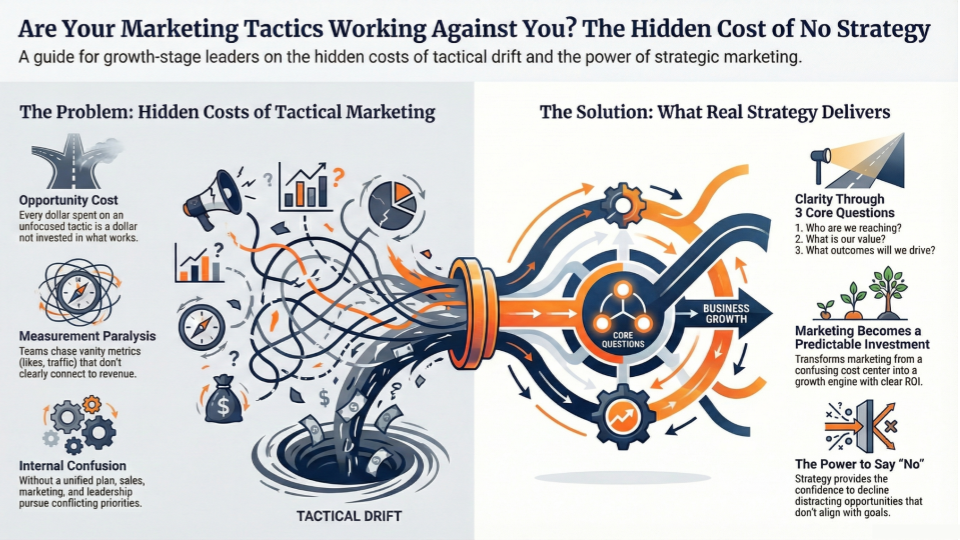
The Real Price of Tactical Drift
When marketing operates without strategic direction, companies don't just waste money on individual campaigns that underperform. The true costs run much deeper.
First, there's the opportunity cost. Every dollar spent on an unfocused tactic is a dollar not invested in the channels and messages that would actually drive growth. A manufacturing company might pour resources into brand awareness campaigns when its sales cycle actually requires deep technical content that nurtures prospects over months. The money spent isn't just wasted—it's actively displacing more effective investments.
Second, tactical marketing creates measurement paralysis. Without a strategic framework, every metric carries equal weight. Website traffic, social engagement, email open rates, and lead counts all compete for attention, but none connect clearly to revenue. Leadership meetings devolve into reviewing vanity metrics rather than discussing whether marketing is actually supporting business objectives. The inability to measure what matters makes it impossible to optimize or justify continued investment.
Third, and perhaps most damaging, is the internal confusion that tactical drift creates. When marketing lacks strategic direction, different stakeholders pursue conflicting priorities. The sales team wants more leads. The CEO wants brand elevation. The operations team wants efficiency. Without a unifying strategy, marketing tries to satisfy everyone and ends up serving no one well.
Why This Happens in Growth-Stage Companies
This pattern isn't random—it follows a predictable trajectory. In the startup phase, founders handle marketing themselves with scrappy, opportunistic tactics. This works fine when the business is small, and the founder can maintain oversight of everything.
But as revenue scales from $3M toward $10M and beyond, the marketing function outgrows founder-led execution. There's too much to do, too many vendors to manage, and too many strategic decisions required. Yet the company hasn't reached the scale to justify a $180,000+ Marketing Director, and leadership isn't certain what that role should even accomplish.
Into this gap rush agencies, consultants, and vendors, each selling their particular solution. None of them are incentivized to step back and ask whether their specific service aligns with broader business objectives. A website redesign firm advocates for a website redesign. A paid search agency pushes more ad spend. Each vendor is competent in their specialty, but no one is orchestrating these efforts toward coherent business outcomes.
What Strategic Direction Actually Means
Strategy isn't about choosing between Facebook and LinkedIn, or deciding whether to attend a trade show. Those are tactical questions that follow from strategic clarity.
Real marketing strategy answers three fundamental questions: Who are we trying to reach? What do we want them to understand about our value? And what specific business outcomes will marketing drive over the next 12-18 months?
With these answered clearly, tactical decisions become straightforward. You know which channels reach your target accounts. You know what messages will resonate. You know how to measure success. Marketing transforms from a cost center that's hard to justify into an investment with predictable returns.
Most importantly, strategy enables you to stop doing things. Every growth-stage company has limited resources. Strategic clarity means confidently saying no to opportunities that don't align with priorities—and feeling good about that decision.
The hidden cost of tactical marketing without strategy isn't just wasted budget. It's the cumulative effect of scattered efforts, confused priorities, and missed opportunities that prevent marketing from becoming the growth engine your business needs.
Ready to transform scattered tactics into strategic growth? If your company has outgrown founder-led marketing but isn't ready for a full-time CMO, a fractional marketing director can provide the strategic leadership you need. You'll get experienced direction that aligns your marketing investments with business objectives—without the overhead of a full-time executive hire. Let's discuss how fractional leadership can bring clarity and measurable results to your marketing efforts.