How to Know When You've Outgrown Founder-Led Marketing
There's a phase in every growing company where the founder handles marketing because, well, someone has to. You know your product better than anyone. You can articulate the value. And frankly, you've gotten this far without a full marketing team—why change now?
Here's the truth: founder-led marketing works brilliantly until it doesn't. And when it stops working, it happens fast. Revenue stalls. Marketing spend increases without clear returns. Your sales team starts asking harder questions about lead quality.
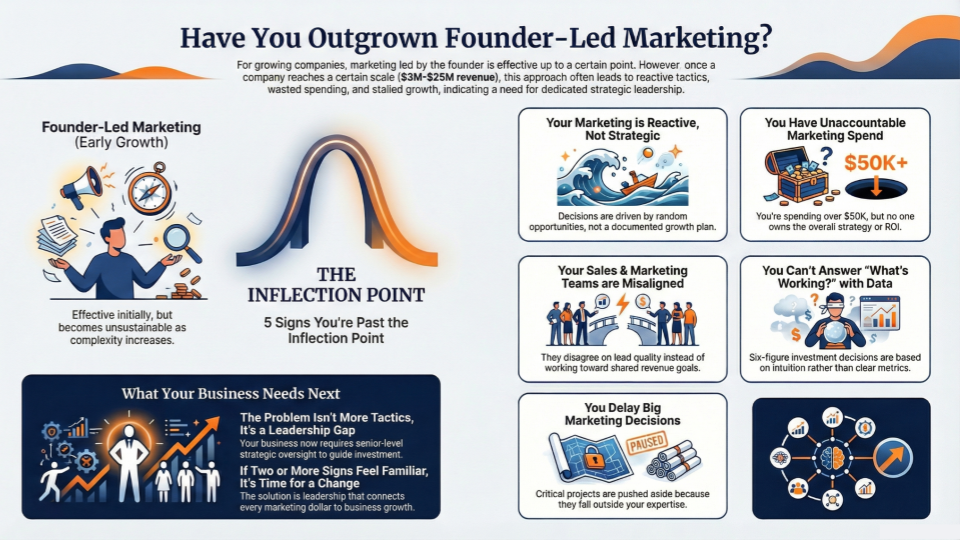
If you're running a company doing $3M to $25M in annual revenue, you're likely approaching—or already past—the inflection point. Here's how to know for sure.
Your Marketing Feels Reactive, Not Strategic
You're responding to opportunities as they come up: a trade show because your competitor will be there, a website refresh because someone mentioned it looks dated, LinkedIn ads because your sales guy read an article.
Nothing wrong with any of those tactics individually. The problem? They're not connected to a coherent strategy. You don't have a documented plan for who you're targeting, what message you're delivering, or what business outcomes you're driving. You're spending money on marketing activities, but you couldn't draw a line from those activities to revenue if someone asked.
Bottom line: When marketing decisions are driven by what landed in your inbox this week rather than a strategic roadmap, you've outgrown founder-led marketing.
You're Spending Real Money With No One Accountable
Look at your marketing spend over the past 12 months. If it's $50K or more—and especially if it's north of $150K—ask yourself: who owns the results?
You're probably working with an agency, maybe a PR firm, perhaps a contractor handling your website. Each vendor is executing their piece. But no one is looking at the whole picture, measuring what's working, or making strategic allocation decisions about where the next dollar should go.
Third, and perhaps most damaging, is the internal confusion that tactical drift creates. When marketing lacks strategic direction, different stakeholders pursue conflicting priorities. The sales team wants more leads. The CEO wants brand elevation. Operations wants efficiency. Without a unifying strategy, marketing tries to satisfy everyone and ends up serving no one well.
That's not a vendor problem. That's a leadership gap. And it's costing you—not just in wasted spend, but in missed opportunities where focused investment could be driving real growth.
Your Marketing and Sales Teams Don't Speak the Same Language
Your sales team complains about lead quality. Marketing says they're hitting their MQL targets. Meanwhile, you're stuck in the middle trying to translate between two groups who should be working toward the same goal: revenue.
This isn't a personality conflict. It's what happens when there's no marketing leader ensuring both teams are aligned on target accounts, messaging, and what actually constitutes a qualified opportunity. When you're handling this yourself between board meetings and operational fires, something breaks down.
You Can't Answer "What's Working?" Without Guessing
Someone asks what marketing channels are driving your best customers. You think it's probably referrals, maybe the website, possibly that conference you sponsored. But you're not certain because nobody's actually tracking this in a way that connects marketing touchpoints to closed revenue.
You're making six-figure decisions about marketing investment based on intuition rather than data. That worked when you were smaller. It doesn't scale.
You're Avoiding Marketing Decisions Because They're Outside Your Expertise
You need to update your positioning. Your website needs a strategic refresh. Your content marketing has stalled. But every time these projects come up, they get pushed to next quarter because you don't have the expertise to drive them forward confidently.
You're exceptional at running your business. You built something worth $3M to $25M in revenue. But you didn't start this company to become a marketing expert—and trying to fill that gap yourself is keeping you from focusing on what you actually do best.
What This Actually Means
If two or more of these scenarios feel uncomfortably familiar, you've outgrown founder-led marketing. Your company is at a stage where marketing needs strategic leadership, consistent oversight, and someone accountable for connecting marketing investment to business outcomes.
The question isn't whether you need marketing leadership. It's whether that leadership needs to be full-time—or if fractional expertise can give you what you need without the overhead.
If you recognized your company in two or more of those scenarios, you already know you need marketing leadership. The question is whether that means hiring a $180,000+ full-time Marketing Director before you're certain what that role should accomplish—or bringing in a fractional marketing director who can provide strategic direction and accountability without the overhead.When you're spending $50K-$300K+ annually on marketing but can't confidently connect it to revenue, the solution isn't more tactics or another vendor. It's senior-level leadership that brings strategic clarity, aligns your teams around measurable outcomes, and ensures every marketing dollar works toward business growth. If you're ready to have that conversation, let's talk about what fractional leadership looks like for your business.