95% of Your Market Isn't Ready to Buy (And Yet, That's Where the Money Is Made)
If your marketing strategy is built around the 5% of buyers who are "ready now," you're fighting over scraps.
Here's what most growth-stage companies miss: the overwhelming majority of your future revenue is sitting with prospects who won't buy from you for another 6, 12, or 18 months. They already purchase what you sell from someone else. They're not actively shopping. They're not responding to your outreach. And frankly, they're not thinking about you at all.
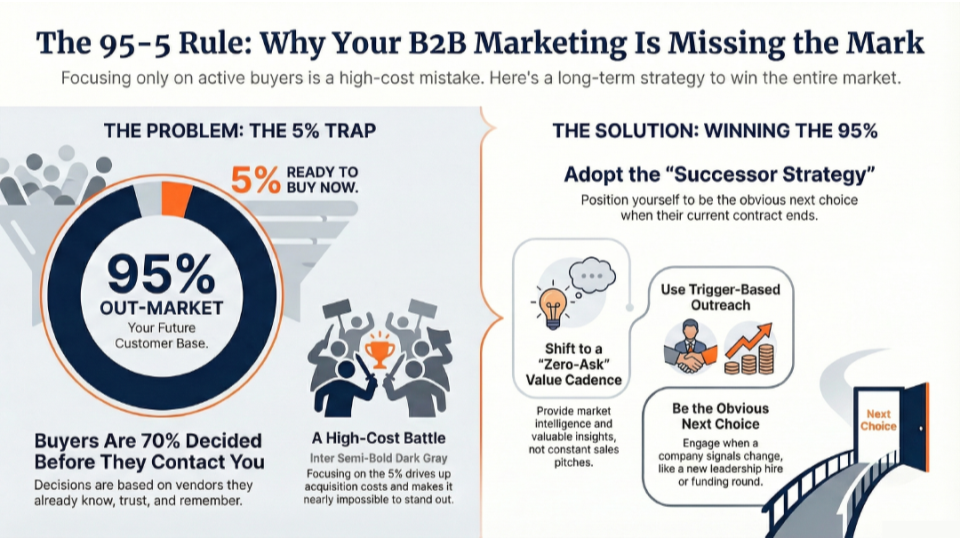
The Math Behind the Madness
Research from the Ehrenberg-Bass Institute and LinkedIn's B2B Institute reveals a pattern that most CEOs struggle to accept: only about 5% of your potential buyers are actively in-market at any given time. The remaining 95% are what researchers call "out-market"—future buyers who aren't yet seeking solutions. (1)
Professor John Dawes, who conducted the original research, found that corporations change service providers like their principal bank or law firm approximately once every five years. That translates to roughly 20% of businesses being in-market over an entire year, or about 5% in any given quarter. (2) For many B2B products and services, the interpurchase cycle is even longer.
This isn't theory. It's observable reality. Think about your own business: When did you last change your accounting firm? Your insurance provider? Your primary vendor relationships? If you're like most companies, these decisions happen infrequently—and when they do happen, you already know who you're calling.
That's the real insight. 6sense research shows that B2B buyers wait until they're approximately 70% through their buying process before they engage directly with vendors. (3) They're not waiting for you to educate them. They're deciding based on who they already know, trust, and remember.
Where Most Companies Get This Wrong
The problem isn't that CEOs don't understand this intellectually. Most do. The problem is that quarterly revenue pressure forces an overinvestment in capturing the 5% who are ready now, while systematically underinvesting in the 95% who represent future growth.
Here's what that looks like in practice: aggressive outbound sequences, paid search campaigns optimized for conversion, sales teams measured on monthly pipeline generation, and marketing budgets allocated almost exclusively to demand capture activities. It's tactical, measurable, and completely focused on this quarter's numbers.
The result? You're competing with every other vendor for the same narrow pool of active buyers. Acquisition costs rise. Differentiation becomes nearly impossible. And when prospects you've never engaged with before suddenly enter the market, they're already 70% through their decision process—and you're not on the list.
The Successor Strategy
An old boss of mine used to call this the Successor Strategy: when the incumbent fails, you're already positioned as the natural next choice.
It's not flashy, but it's accurate. When contract frustration finally outweighs switching inconvenience—and it always does eventually—that 70% of your market will move. The question is whether they'll think of you when they do.,/p>
That requires a different approach:
Identify the Decision Maker
Not the procurement team. Not the end user. The person who actually makes or heavily influences vendor selection decisions in your target accounts.
Learn Where They're At Now
Who's their current provider? What does their contract structure look like? What's working? What's not? This isn't information you get from a form fill. It comes from genuine relationship-building.
Capture the Contract Review Date
This is the single most valuable piece of intelligence in long-cycle B2B sales. When does their current agreement come up for renewal? That's your window.
Stay Visible Before That Window Opens
This is where most strategies fall apart. "Staying visible" doesn't mean a monthly newsletter no one reads. It means systematic, valuable engagement over extended time horizons.
Build Trust Slowly, Quietly, Consistently
When things change—and they always do—you need to be the obvious next call. That position is earned through demonstrated expertise and genuine relationship equity, not aggressive prospecting cadences.
How to Actually Nurture for the Long Game
Most companies claim to nurture long-term prospects. Few actually do it well. Here's what works:
Separate "Active" from "Nurture" in Your CRM
This sounds basic, but it's critical. Active leads get aggressive sequences because time matters. Nurture contacts get an entirely different treatment—one that doesn't destroy the relationship before it starts. If you're auto-enrolling 18-month prospects into 14-day "touch" sequences, you're burning future pipeline.
The Zero-Ask Cadence
Throw out the standard sales cadence for long-horizon accounts. Move to low-frequency, high-value rhythm: one meaningful touchpoint every 4-6 weeks, not seven emails in two weeks.
The rule: every interaction must pass the value test. If the prospect reads your email and doesn't reply, did they still learn something useful? If not, don't send it.
Send market intelligence, not product information. Example: "Saw this regulatory change affecting aerospace procurement. Here's a two-minute summary of how it might impact your vendor qualification process. No need to reply." That's valuable. "Checking in to see if you're ready to evaluate our solution" is not.
Social Orbiting Over Direct Outreach
LinkedIn connection requests that immediately pitch your service are the professional equivalent of proposing on a first date. Instead, orbit the key stakeholders. Comment meaningfully on their posts. Share (don't create) relevant industry analysis they'd actually want to see. Position yourself as an industry insider, not a vendor trying to close.
Become a Super-Connector
Make yourself valuable to them personally, not just commercially. If you know they're hiring and you have a strong candidate referral outside your competitive space, make the introduction. If you're hosting a private peer dinner with other directors in their role, invite them. Facilitate their success independent of whether they ever buy from you.
Trigger-Based Outreach, Not Time-Based
Stop nurturing on a schedule. Start nurturing based on change. Set up alerts for new leadership hires (new VPs often re-evaluate vendors within 90 days), funding rounds, M&A activity, or job postings that signal upcoming needs. When you see the trigger, that's when you reach out—with context about why now matters.
The Dark Funnel Content Strategy
Accounts 12-18 months out aren't searching for solutions. They're not even fully aware they have a problem yet. Your content needs to create problem awareness before solution awareness.
Don't write "Why Our Software Is Faster" (solution-aware). Write "The Hidden Cost of Legacy Systems in 2025" (problem-aware). Long-form industry reports, benchmark studies, and trend analysis have extended shelf life and position you as a thought leader, not a vendor.
Intent-Based Retargeting
Don't waste budget showing "Book a Demo" ads to people who won't be ready for 12 months. Run low-frequency brand awareness ads to specific accounts just to keep your logo familiar. Then use intent data platforms (6sense, Bombora, G2) to monitor when these cold accounts start researching your category. When the signal spikes, that's when marketing alerts sales to shift from "Nurture" to "Active Pursuit."
The Timeline Reality
This framework assumes a minimum 90-day planning window. That's not arbitrary—it's what actually works.
Hospitality venues book up. Content production takes time. Email sequences need testing. Advertising campaigns require optimization. Sales teams need talking track preparation.
Trying to execute this with 30 days notice means compromising on quality or skipping steps entirely. Neither drives the results you're paying for.
What Success Actually Looks Like
Let's be specific about what this framework generates for a 2.5-day trade show with 20,000 attendees:
The Bottom Line
Businesses that focus exclusively on immediate demand capture are optimizing for short-term survival while sacrificing long-term growth. The companies that win consistently are playing a different game: they're building relationships and brand awareness with future buyers long before those buyers enter the market.
This requires patience. It requires investment without immediate return. And it requires leadership willing to fund activities that won't show up in this quarter's pipeline report.
But here's the truth: your competitors aren't doing this. They're chasing the same 5% you are, using the same tactics, fighting the same uphill battle. That 70% who will need what you sell over the next 12-24 months? They're wide open.
The question is whether you're building relationships with them now, or waiting until they're already 70% through a buying process you're not part of.
Most growth-stage companies lack the leadership to build relationships with that 95% while still capturing the 5% ready to buy today. If you're facing this challenge, a fractional Marketing Director can architect the dual-track strategy your business needs—without the $180K+ overhead of a full-time hire.
References
(1) John Dawes, "Advertising effectiveness and the 95-5 rule: most B2B buyers are not in the market right now," Ehrenberg-Bass Institute for Marketing Science / LinkedIn B2B Institute, May 2021. https://marketingscience.info/advertising-effectiveness-and-the-95-5-rule... https://business.linkedin.com/marketing-solutions/b2b-institute/b2b-research/trends/95-5-rule
(2) Ibid. Dawes notes: "Corporations change service providers such as their principal bank or law firm around once every five years on average. That means only 20% of business buyers are 'in the market' over the course of an entire year; something like 5% in a quarter." PDF: https://business.linkedin.com/content/dam/me/business/en-us/marketing-solutions/resources/pdfs/advertising-effectiveness-and-the-95-5-rule.pdf
(3) 6sense, "2023 B2B Buyer Experience Report," conducted June-July 2023, survey of 900+ B2B buyers. The research found that "buyers consistently refrain from engaging directly with selling organizations until they are approximately 70% through their buying process." https://6sense.com/blog/dont-call-us-well-call-you-what-research-says-about-when-b2b-buyers-reach-out-to-sellers/ https://6sense.com/newsroom/84-of-b2b-deals-are-decided-before-marketers-even-know-about-them/